St. Mary Magdalene Catholic Church • Newnan, Georgia
Dear Brothers and Sisters in Christ,
We are overjoyed to invite you to join us on this extraordinary pilgrimage to Poland and the Czech Republic — the homeland of St. John Paul II, the birthplace of the Divine Mercy devotion, and the land where the Catholic faith has been forged through centuries of suffering, martyrdom, and joyful witness. Together with Fr. Michael Revak and your fellow parishioners, you will walk in the footsteps of the Church’s greatest modern saints and return home renewed in faith, hope, and trust in God’s limitless mercy.
Poland and the Czech Republic are not distant historical relics — they are living testaments to what the human heart can achieve when fully surrendered to God. From the miraculous icon of the Black Madonna at Częstochowa to the Chapel of St. Kinga carved entirely from salt deep beneath the earth, from the quiet garden where Divine Mercy was revealed to the world to the cobblestones of Wawel Hill where a future pope walked as a young priest, every day of this pilgrimage is an encounter with saints who have gone before us.
With over 30 years of experience, Tekton Ministries guides Catholic pilgrims not as tourists collecting photos but as seekers encountering the living God. Every detail of this journey — from daily Mass at sacred sites to the carefully chosen reflections for each day — is designed to lead you deeper into relationship with Christ and His boundless mercy.
A pilgrimage is not a vacation with churches. It is one of the most ancient spiritual disciplines in the Christian tradition — a physical journey that mirrors the interior journey of the soul toward God. The difference between a tourist and a pilgrim is not the itinerary; it is the posture of the heart.
“The Magi returned to their country by a different way.” This single verse from Matthew’s Gospel (2:12) captures the entire purpose of pilgrimage. In Poland and the Czech Republic, the transformation you seek is waiting — in the chapel where St. Faustina first received the Divine Mercy image, in the Basilica where a future pope knelt as a child, and at the gates of Auschwitz where St. Maximilian Kolbe walked to his death with a prayer on his lips. The goal is not to photograph every site — it is to encounter the saints of God so profoundly that you cannot return to your old life.
Before you leave, write down 3 to 5 specific intentions — a vice you want conquered, a person you need to forgive, a virtue you desperately need. Do not be vague. “Pray for my family” is a start; “Pray for my son’s return to the Faith” is a pilgrimage intention. Carry these with you to every sacred site and place them before the image of Divine Mercy at Łagiewniki.
St. John Paul II, St. Maximilian Kolbe, St. Faustina Kowalska — these are not figures from a distant century. Their witness was forged in the same cities, streets, and chapels you will soon visit. Before you depart, read even a brief account of their lives. When you stand in Wadowice or before the cell in Auschwitz where a priest gave his life for a stranger, you will not be a tourist; you will be a pilgrim continuing their story.
Our visit to Auschwitz-Birkenau is not a museum tour — it is an act of witness. The day will be heavy, and it should be. Let yourself feel the weight of it. Offer your sorrow as a prayer for all who suffered there, and recall that in the midst of that darkness, St. Maximilian Kolbe stepped forward and said, “I am a Catholic priest. Let me take his place.” This is what grace looks like in the face of evil.
Read about St. John Paul II, St. Faustina, and St. Maximilian Kolbe. Their lives will illuminate every shrine you visit and transform the journey from history into encounter.
Speak with Fr. Revak about scheduling a Confession before we depart — arriving in a state of grace will open your heart to the fullest graces of this pilgrimage.
Join Fr. Revak and your fellow pilgrims for Pilgrim Heart — A Pre-Pilgrimage Retreat (7 Sessions). This guided spiritual preparation, included with your pilgrimage, transforms a journey into a true pilgrimage.
“By A Different Way: A Catholic Guide to Pilgrim Spirituality” by Fr. Clinton Sensat. Also consider “Diary: Divine Mercy in My Soul” by St. Faustina Kowalska.As an Amazon Associate, Tekton Ministries earns from qualifying purchases at no additional cost to you.
The Eucharist celebrated at the very sites where modern saints prayed, suffered, and triumphed is the heart of this pilgrimage.
Keep a small journal. Write what moved you, what surprised you, what challenged you. Your grandchildren will treasure it.
The Divine Mercy Chaplet, especially at the 3 PM Hour of Mercy, is particularly powerful on this pilgrimage. Bring a chaplet.
Throughout this journey, we will pray for:
Our spiritual pilgrimage begins today as we board our transatlantic flight to Warsaw, the vibrant capital of Poland. Meals and refreshments will be served aloft. Use this time of transition to begin setting your heart on what lies ahead — pray your intentions, read the preparation materials, and ask the Holy Spirit to open your eyes to what He wishes to show you in this extraordinary land of saints and martyrs.
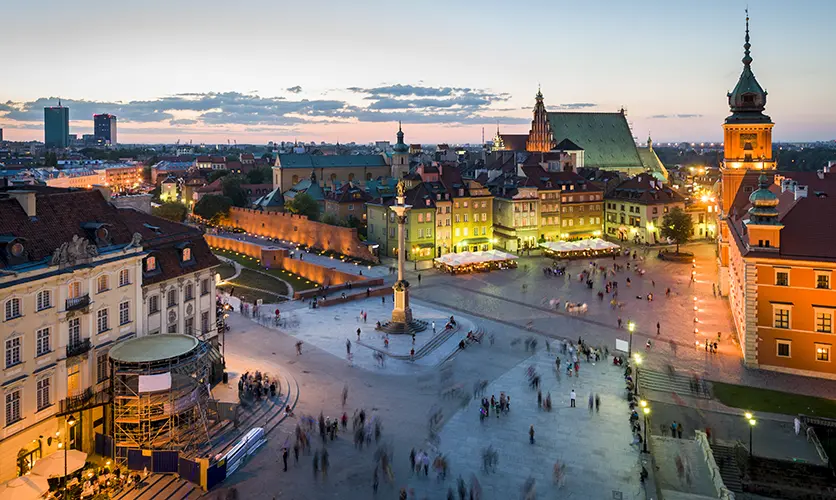
Warsaw’s Old Town Market Square — rebuilt stone by stone after its near-total destruction in World War II
Upon arrival in Warsaw we will be met by our pilgrimage manager, who will remain with us for the duration of our journey. We will transfer to our hotel for check-in and settle into our first of two nights in this remarkable city — a living symbol of Poland’s resilience, faith, and indomitable spirit.
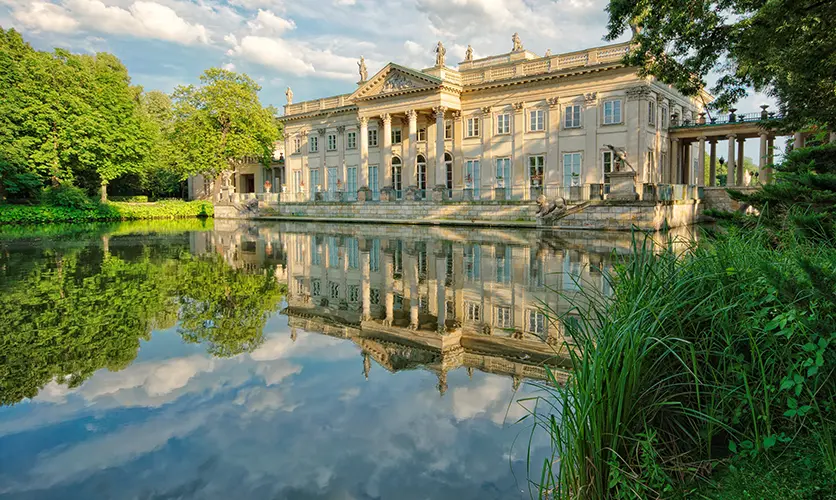
The Palace on the Isle in Łazienki Royal Park — Warsaw’s most beautiful green space
We begin our day with Mass at St. Stanisław Kostka Church, where the martyred Solidarity priest Father Jerzy Popiełuszko worked and is buried. Father Popiełuszko’s courage in speaking truth to communist power — and his murder by the secret police in 1984 — made him one of the most powerful symbols of faith, freedom, and the power of the Gospel in modern Poland.
Enjoy a guided tour of Warsaw including visits to the Cathedral of St. John, the Royal Castle, the Old Town Square, the Barbican and City Walls, and Zygmunt’s Column. Follow the Royal Route to Łazienki Park where we will see the Palace on the Water.
We end our day with a visit to Niepokalanow — the “City of the Immaculata” founded by St. Maximilian Kolbe as a center of Marian devotion and the apostolate of print media. Here we visit the Shrine of Our Lady Immaculate and St. Maximilian Kolbe, offering our prayers in the place where he built his great work of faith before his arrest and deportation to Auschwitz.
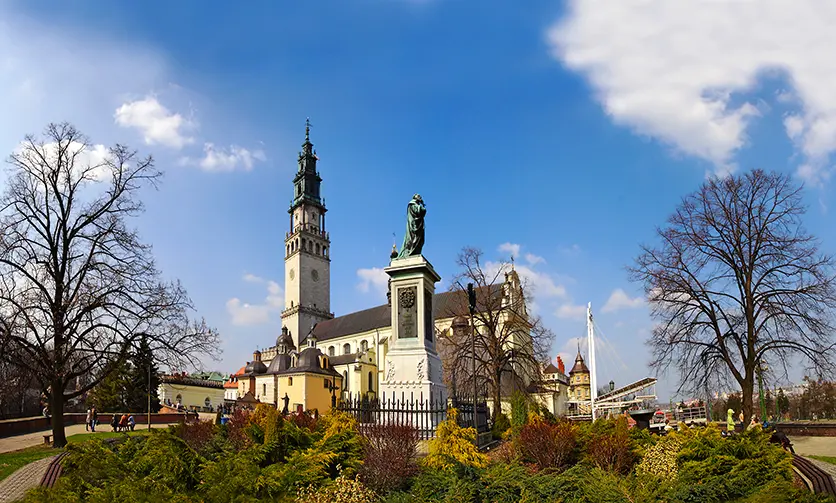
The Jasna Góra Monastery in Częstochowa — Poland’s most beloved national pilgrimage shrine
We depart Warsaw this morning and drive to Częstochowa, the most visited pilgrimage site in Poland, where Our Lady has been called the “Queen of Poland” for centuries. Here we visit the Jasna Góra Monastery — a spiritual fortress that has stood as the heart of Polish Catholic identity through invasions, partitions, and communist oppression. We visit the Treasury, Knight’s Hall, Refectory, and the Basilica of the Holy Cross and Nativity of the Virgin Mary.
The highlight of our visit is viewing the miraculous icon of Our Lady of Częstochowa — the Black Madonna — to which countless miracles have been attributed over seven centuries. We celebrate Mass before this beloved image. After Mass we proceed south to Kraków, our home base for the next four nights.
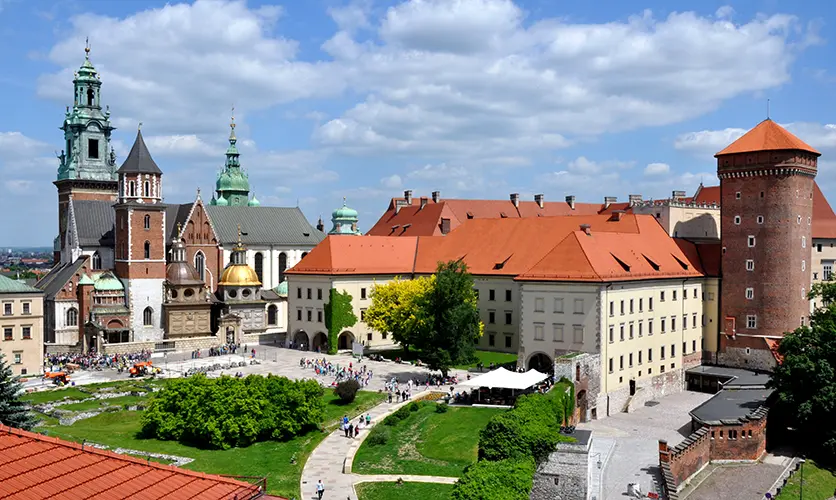
Wawel Cathedral on Wawel Hill — Poland’s second most important pilgrimage shrine and coronation church of Polish kings
Following breakfast, we proceed to Wawel Hill to celebrate Mass at the Cathedral of St. Stanisław — Poland’s second most important pilgrimage shrine, the resting place of Polish kings, and the church where a young Karol Wojtyla served as a priest and cardinal. Continue to the Basilica of the Holy Trinity, the Gothic Dominican church originally built in the 13th century.
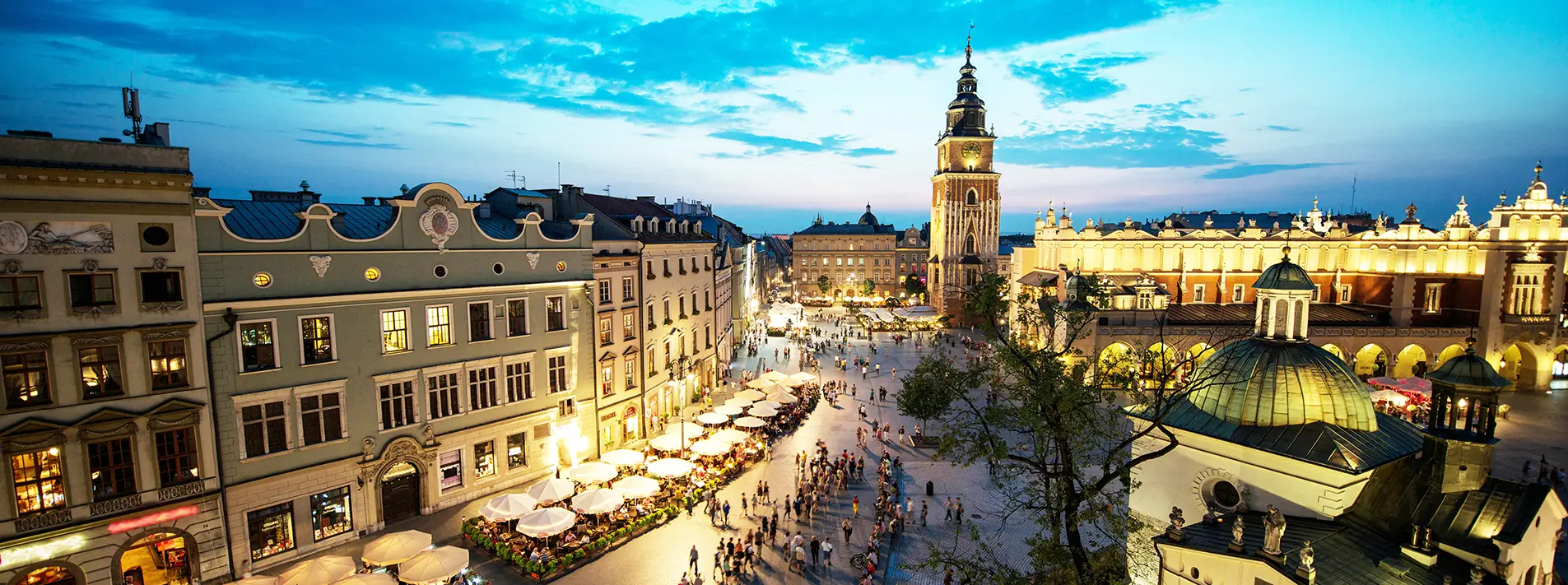
We continue through Kraków’s Old Town to the great Market Square, the Church of St. Mary, the City Hall Tower, Kanonicza Street where the future Pope John Paul II resided as Archbishop, and the courtyard of the Collegium Maius where he studied philosophy and theology as a young man.
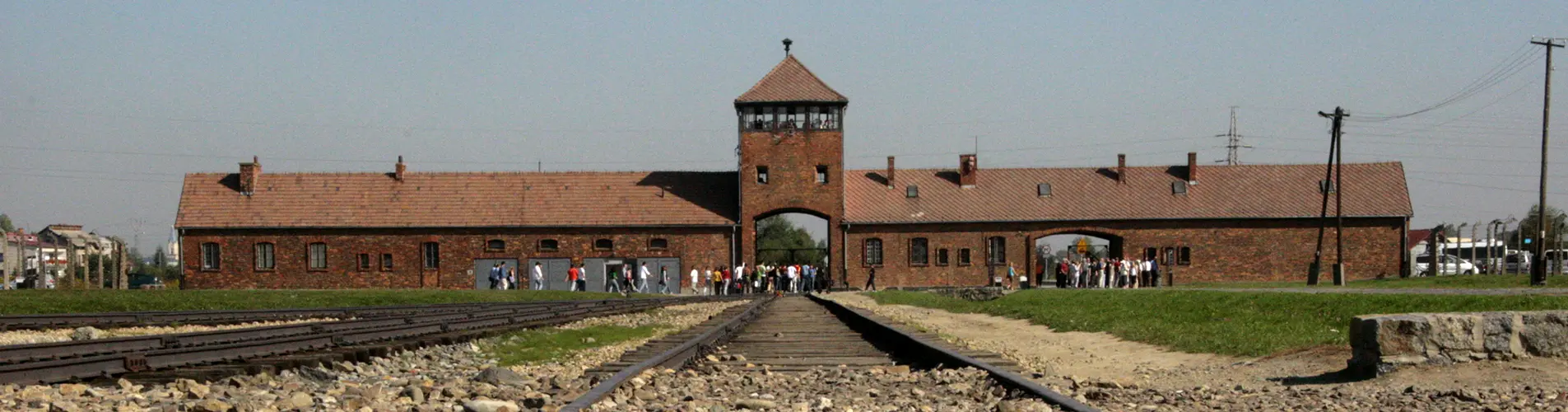
In the afternoon we travel to Auschwitz-Birkenau to pay our respects at this solemn memorial, where over a million people were killed during the Second World War. Both St. Edith Stein and St. Maximilian Kolbe were murdered here, along with millions of innocent Jews, Christians, and Poles. St. Maximilian was starved and faced lethal injection after he volunteered his own life for a fellow prisoner. We visit his cell and the Martyrdom Museum before returning to Kraków.
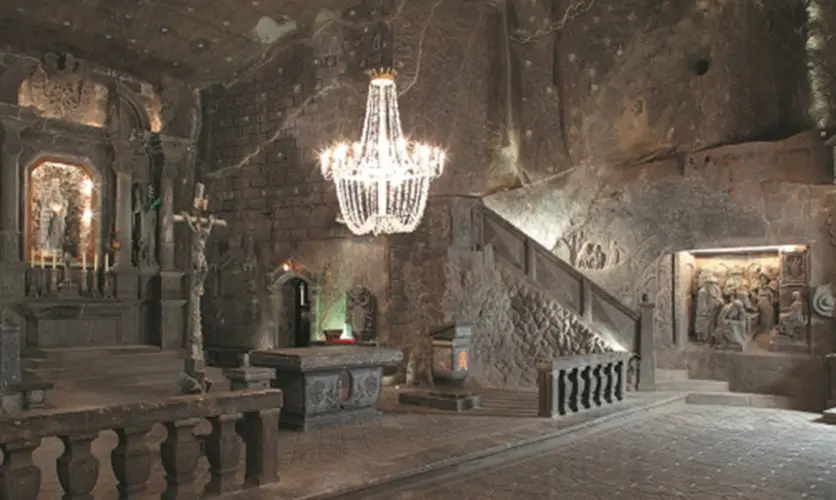
St. Kinga’s Chapel in the Wieliczka Salt Mine — chandeliers, bas-reliefs, and altars carved entirely from salt
This morning we travel to Wieliczka to visit one of the oldest working salt mines in Europe and a UNESCO World Heritage Site. Descend 135 meters underground into a breathtaking world of chambers, corridors, and chapels carved over centuries by Polish miners. The crown jewel is the magnificent Chapel of St. Kinga — a full cathedral carved entirely from rock salt, complete with chandeliers, elaborate bas-reliefs depicting scenes from the New Testament, and altarpieces fashioned from the same salt.
In the afternoon we journey to the Divine Mercy Shrine in Łagiewniki, where Saint Faustina Kowalska — Apostle of Divine Mercy — lived and died. Enjoy a guided tour of the shrine including the convent chapel and St. Faustina’s tomb. Venerate the original image of Divine Mercy and the relics of St. Faustina. Listen to a talk from one of the sisters of her Order. Pray before a relic of St. John Paul II in the center “Have No Fear,” named for his words at the beginning of his pontificate.
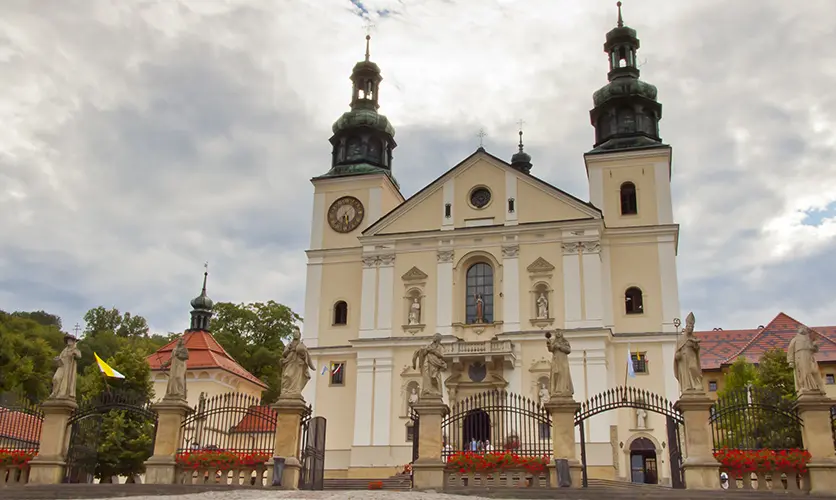
Kalwaria Zebrzydowska — one of St. John Paul II’s most beloved pilgrimage sites, a UNESCO World Heritage landscape of faith
Today we walk in St. John Paul II’s footsteps as we retrace much of his early life, beginning with Wadowice where Karol Wojtyla was born in 1920. We celebrate Mass at the Gothic Basilica of the Presentation of the Virgin Mary, the very church where the future pope was baptized, received his first Holy Communion, and was confirmed. Admire the Baroque nave and pray before the miraculous picture of Our Lady of Perpetual Help, before which the young Karol prayed every day. Explore the Wojtyla family home museum, with personal relics and belongings from his youth.
Our next stop is Kalwaria Zebrzydowska — a place JPII called one of his great loves from youth. This UNESCO World Heritage site began in the 17th century when a Polish nobleman built a replica of the Chapel of the Holy Cross in Jerusalem. Over the centuries it grew to encompass replicas of the Tomb of Christ, the Mount of Olives, the Home of Caiaphas, and other Holy Land sites. Today 43 chapels and shrines are scattered across four kilometers of hills, honoring the Way of the Cross, the Mysteries of the Rosary, and the Seven Sorrows of Mary.
We depart this morning for the Czech capital of Prague, one of Europe’s most stunningly beautiful and well-preserved cities. En route, we stop in Brno to visit the Old Town and celebrate Mass at the Cathedral of Sts. Peter and Paul — a national cultural monument and a masterpiece of South Moravian Gothic architecture. A curiosity: the cathedral bells ring the noon hour one hour early, to commemorate a historic victory over Swedish forces during the Thirty Years’ War. Upon arrival in Prague, we check in at our hotel.
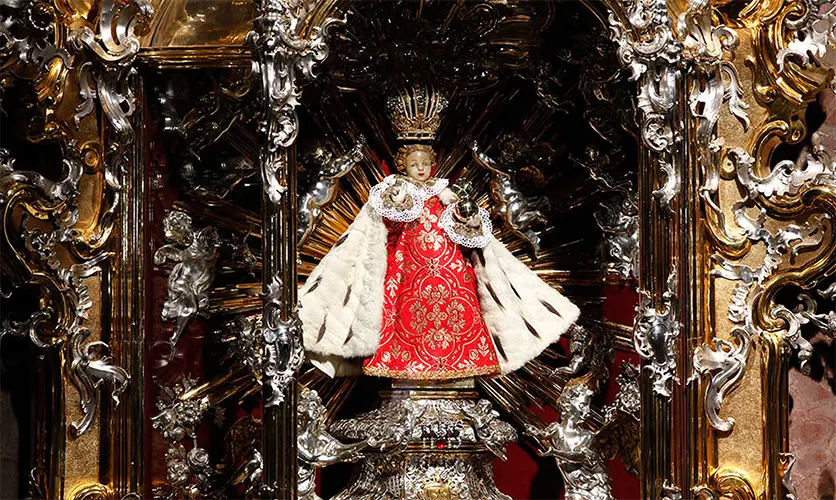
The venerated statue of the Infant Jesus of Prague at the Church of Our Lady Victorious — beloved by Catholics throughout the world
We begin with a visit to the Loreto Shrine, one of the most important pilgrimage sites in the Czech Republic, housing a faithful replica of the Holy House of the Virgin Mary from Nazareth. Then we proceed to Prague Castle to visit the magnificent St. Vitus Cathedral, St. George’s Basilica, the picturesque Golden Lane, the Royal Palace, and St. George’s Convent.
We continue to Malá Strana — “The Little Quarter” — with its wealth of Baroque architecture. Here we visit the Church of St. Nicholas and the Church of Our Lady Victorious, where we venerate the famous Infant Jesus of Prague — the miraculous wax statue venerated by the faithful for over four centuries — and celebrate Mass.
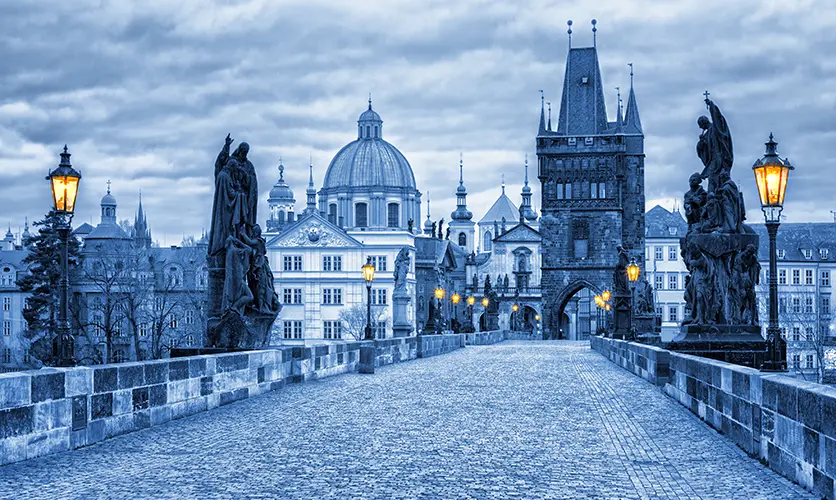
The Charles Bridge — Prague’s most iconic landmark, lined with 30 Baroque statues of saints including St. John Nepomuk
This morning we cross the Charles Bridge, named for King Charles IV and lined with 30 magnificent Baroque statues of saints, to visit Prague’s Old Town — widely considered one of the finest historical city centers in Europe. We explore the Old Town Square, the Town Hall with its famous Astronomical Clock (which comes alive each hour as the twelve apostles appear), the Church of Our Lady before Týn, and the Church of St. Nicholas.
In the afternoon we excursion to Kutná Hora to visit the Sedlec Ossuary — the “Bone Church” — containing the exhumed remains of up to 40,000 people, arranged in striking artistic patterns as a powerful and sobering meditation on our mortality and the hope of the resurrection.
This evening we enjoy a farewell dinner at a local Prague restaurant, celebrating the many graces of this pilgrimage together.
Following breakfast, we transfer to the airport for our return flight home, carrying with us all the blessings and graces of this pilgrimage through the land of saints. Like the Magi who “returned to their country by a different way,” we go home transformed — not merely as tourists with photographs, but as pilgrims carrying seeds of grace that will continue to bear fruit in our lives, our families, and our parish community for years to come. Jesus, I trust in You.
“I desire that the Feast of Mercy be a refuge and shelter for all souls, and especially for poor sinners. On that day the very depths of My tender mercy are open. I pour out a whole ocean of graces upon those souls who approach the fount of My mercy.”— Jesus to St. Faustina Kowalska, Diary: Divine Mercy in My Soul, 699
This pilgrimage involves moderate walking through city centers, historic Old Towns, and pilgrimage shrines. Terrain includes cobblestones, stairs, and occasional uneven surfaces typical of European cities. The Wieliczka Salt Mine involves a staircase descent (well-paced by guides). Expect 3–5 miles (8,000–10,000 steps) per day. November temperatures are cold — warm layers, gloves, and a waterproof outer layer are essential. Comfortable, well-broken-in walking shoes are strongly recommended.
| Base price per person | $3,680 |
| Air taxes / fuel surcharges | $752.46 |
| Estimated Total Per Person | $4,432.46 |
Pricing is estimated. Air taxes and fuel surcharges are subject to change and will be updated on the final invoice, which will be emailed approximately three months prior to departure. Gratuities for guides, drivers, and hotel staff (approximately $180 per person) are added to the final invoice and are not included in the estimated pricing above. Contact Tekton Ministries for information about single room supplements and/or land-only pricing.
Average conditions for early-to-mid November in Poland & the Czech Republic
Dress in warm layers appropriate for late autumn in Central Europe — thermal base layers, sweaters, a heavy coat, gloves, hat, and scarf are recommended. Modest attire is required at all churches and sacred sites (shoulders and knees covered). Comfortable, well-broken-in waterproof walking shoes are essential for cobblestone streets and uneven terrain.
“A tourist looks for souvenirs; a pilgrim looks for seeds of grace. The difference between the two determines whether your trip becomes a dusty photo album or a profound turning point in your life.”— “By A Different Way: A Catholic Guide to Pilgrim Spirituality”